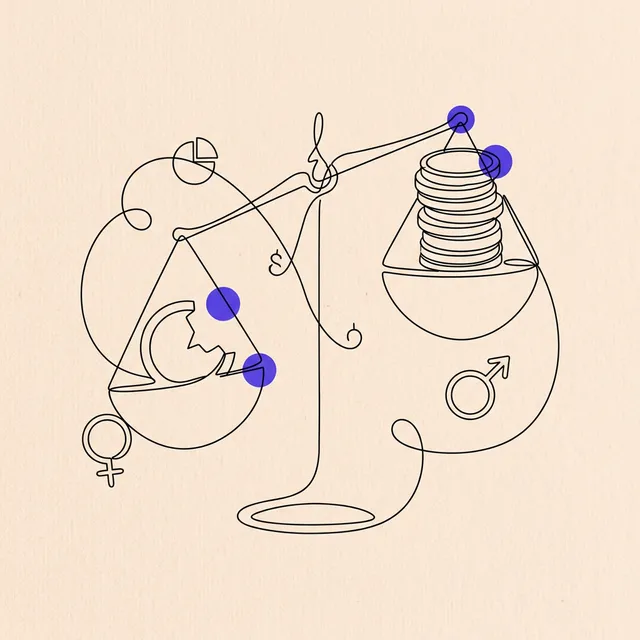
The Gender Wealth Gap: When Money Dysmorphia is Actually Just Math
50% of women globally report financial anxiety. Explore how the gender wage gap blurs the line between money dysmorphia and a valid financial reality.
“Money Dysmorphia” is trending. It’s defined as a psychological distortion where individuals feel a pervasive sense of financial inadequacy, despite objective evidence that they are financially stable. It’s often blamed on social media and comparison culture.
But for women, there’s a serious flaw in this diagnosis. What happens when your feeling of being “behind” isn’t a distortion at all, but a mathematically accurate reflection of systemic inequality? When women report higher levels of financial anxiety than men (50% vs 41% globally), it’s crucial to examine whether it’s truly dysmorphia, or simply the psychological toll of the gender wage gap.
At a Glance: Anxiety vs. Reality
- Is it all in your head? Not necessarily. In 2024, women working full-time, year-round still earned roughly 83 cents for every dollar earned by men, meaning the feeling of having “less” is mathematically valid.
- The compound effect: Earning 17% less means lower baseline contributions to savings and investments, significantly reducing the power of compound interest over a career.
- Finding security: Overcoming this anxiety requires ruthless budgeting and prioritizing aggressive investments to bridge the gap.
The Reality of the “83 Cents” Deficit
Money dysmorphia implies that your fear of scarcity is irrational. But for many women, the scarcity is quantifiable.
Consider the fundamental math: If a man and a woman work the identical full-time job, but the woman earns 83% of the man’s salary, her margin for error is substantially thinner. She has less disposable income to absorb inflation, less capital to funnel into an emergency fund, and less discretionary money to dedicate to investing. It is entirely rational to feel stressed about money when the systemic deck is stacked to make your financial journey steeper.
For women of color, the math is even more severe, with Latina women earning roughly 58 cents and Black women roughly 67 cents to a White man’s dollar. Labeling the resulting stress as “dysmorphia” risks gaslighting women about their very real financial hurdles.
The Motherhood Penalty and Financial Fear
A major driver of female financial anxiety is the “motherhood penalty.” Taking time out of the workforce for caregiving doesn’t just halt salary progression; it interrupts the critical early years of retirement compounding.
When a woman in her 30s feels an intense drive to hoard cash or a deep fear of retirement poverty, she may be accurately projecting the long-term impact of her career interruptions. Her male peers, who historically face less earning disruption from family rearing, may not share this specific brand of financial panic.
Transforming Anxiety into Action
While the systemic issues are real, operating in a state of chronic financial panic is unsustainable. To differentiate between valid wage-gap stress and paralyzing money dysmorphia, you need a rigid, objective framework.
- Stop Internalizing the Gap: Recognize that feeling “behind” your male peers is often a structural issue, not a personal failing. Do not let systemic inequality dictate your self-worth.
- Demand Your Value: Aggressive negotiation isn’t just a career strategy; it’s a mental health imperative. Closing your personal wage gap is the fastest way to relieve financial anxiety.
- Implement Precision Budgeting: When your margins are thinner, your budget must be sharper. Use the 50/30/20 framework to enforce balance. By mathematically guaranteeing that 20% of your income is always building your safety net, you provide your brain with the concrete proof it needs to stop panicking.
Conclusion
It’s okay to acknowledge that the math is harder for women. But you cannot let the reality of the wage gap evolve into a paralyzing fear of the future. By anchoring your cash flow in solid numbers using our Budget Planner, you can ensure you’re maximizing every dollar you earn and proactively building the safety net you deserve.
Disclaimer
This analysis is for educational purposes only and does not constitute financial advice. The models presented are projections based on historical data and specific assumptions that may not apply to your unique situation. Always consult with a certified financial professional.
Content on StashPlanner is created with the assistance of Artificial Intelligence. While we fact-check against high-authority sources, AI can occasionally hallucinate or get details wrong. Please use this content as a starting point and always conduct your own due diligence.