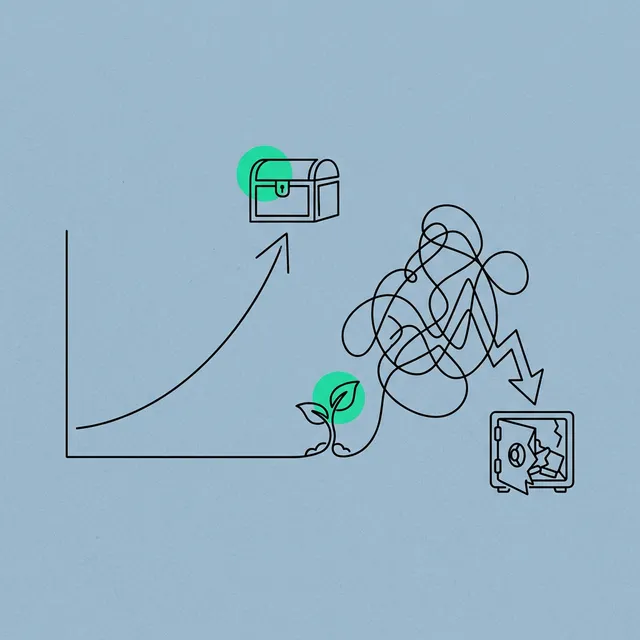
Index Funds vs. Active Management: Why Boring Wins
Discover why 65% of active managers fail to beat the market and how switching to index funds can save you thousands in fees.
It’s the oldest pitch in Wall Street’s playbook: “Don’t just settle for average returns. Let our experts beat the market for you.”
It sounds intuitive. In every other area of life—sports, medicine, law—hiring a professional yields better results than doing it yourself. But investing is the rare exception where “hiring a pro” often guarantees a worse outcome.
The data is in, and it’s damning. If you’re paying high fees for active management, you aren’t just paying for underperformance—you’re compounding it.
The Scorecard: Active Managers Are Losing
Every year, S&P Dow Jones Indices releases their SPIVA (S&P Indices Versus Active) report, the gold standard for measuring active fund performance. The numbers for 2024 and mid-2025 tell a consistent story:
- 65% Failure Rate: In 2024, nearly two-thirds of actively managed large-cap U.S. equity funds failed to beat the S&P 500.
- No Long-Term Safe Harbor: Over a 15-year period ending in 2024, zero U.S. equity categories saw a majority of active managers outperform their benchmarks.
- The Trend Continues: Early data from mid-2025 shows 54% of managers still lagging behind.
When you buy an index fund, you are guaranteed to get the market return (minus a tiny fee). When you buy an active fund, you are statistically likely to get less than the market return.
The Silent Wealth Killer: Expense Ratios
Why is it so hard for professionals to win? In a word: Fees.
Active management is expensive. You have to pay for research teams, trading desks, luxury offices, and marketing. These costs are passed to you as an Expense Ratio.
- Average Active Fund Fee: ~0.5% to 1.5%
- Average Index Fund Fee: ~0.03% to 0.2%
It might sound small. What’s 1% between friends? But over decades, that 1% difference is catastrophic.
The Math: $100,000 over 30 Years
Let’s run the numbers assuming a 10% annual market return.
- Scenario A (Index Fund): 0.05% fee.
- Scenario B (Active Fund): 1.00% fee.
| Year | Index Fund Value | Active Fund Value | Difference (Lost to Fees) |
|---|---|---|---|
| Year 10 | $257,000 | $234,000 | $23,000 |
| Year 20 | $664,000 | $551,000 | $113,000 |
| Year 30 | $1,710,000 | $1,295,000 | $415,000 |
The Result: You lose over $400,000 simply by choosing the expensive fund. That’s not money the manager “lost” in the market; that’s money they took from your pocket, regardless of performance.
The Tax Advantage
It gets worse. Active managers trade frequently, buying and selling stocks to try and time the market. Every time they sell a stock for a profit, it generates a taxable capital gains distribution. You have to pay taxes on that distribution, even if you never sold a single share of your fund.
Index funds are passive. They only trade when the index changes (which is rare). This “low turnover” means you defer taxes until you decide to sell, allowing your money to compound tax-free for longer.
Where Does Your Portfolio Stand?
Are your investments working for you, or for your fund manager? It’s time to check your expense ratios and project your true long-term wealth.
Use our Wealth Calculator to simulate different fee structures and see how much difference a 1% fee makes to your retirement date.
Conclusion
Investing doesn’t need to be complicated to be effective. In fact, the most effective strategy is often the simplest: buy the whole market, keep your fees rock-bottom, and wait. Boring? Maybe. But retiring with an extra $400,000 sounds pretty exciting to us.
Disclaimer
This analysis is for educational purposes only and does not constitute financial advice. The models presented are projections based on historical data and specific assumptions that may not apply to your unique situation. Always consult with a certified financial professional.
Content on StashPlanner is created with the assistance of Artificial Intelligence. While we fact-check against high-authority sources, AI can occasionally hallucinate or get details wrong. Please use this content as a starting point and always conduct your own due diligence.