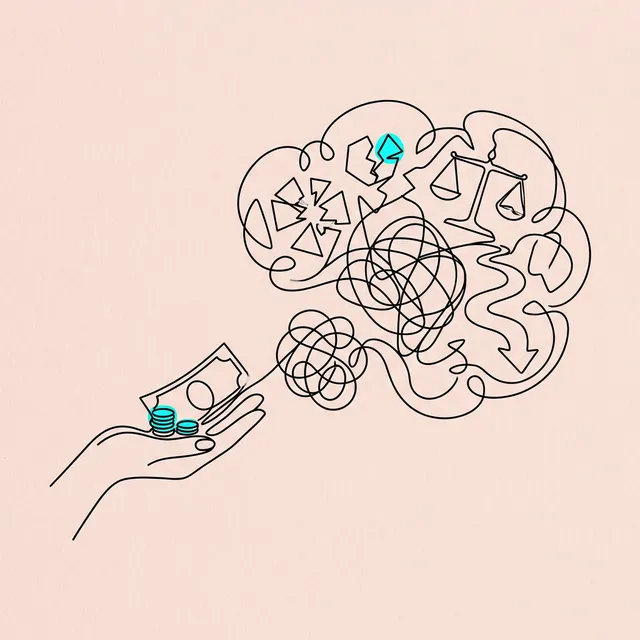
Money Dysmorphia: Why You Feel Broke (Even When You're Not)
Nearly 43% of Gen Z and 41% of millennials suffer from Money Dysmorphia. Learn to identify the symptoms and fix your distorted financial reality.
Do you constantly feel like you’re falling behind financially, despite having a steady income and money in the bank? Does checking your bank account fill you with dread, or do you compulsively check it multiple times a day? You might be experiencing a phenomenon known as Money Dysmorphia.
Much like body dysmorphia, money dysmorphia is a distorted view of your own financial reality. It causes pervasive anxiety, hoarding tendencies, or extreme overspending, driven by a deep-seated belief that you simply do not have enough—regardless of what the math says.
At a Glance: Money Dysmorphia
- What is it? A psychological disconnect between your actual financial health and your perceived financial security.
- Who is affected? It heavily impacts younger Americans, with 43% of Gen Z and 41% of millennials reporting symptoms, largely fueled by social media comparison culture.
- How do you fix it? Stop comparing your “behind the scenes” to a billionaire influencer’s highlight reel. Instead, rely on hard math and automated budgeting to ground your financial perspective.
The Symptoms of Financial Distortion
Money dysmorphia doesn’t discriminate based on income. In fact, a recent study found that among those identifying with money dysmorphia, 37% had over $10,000 in savings. The math doesn’t align with the emotion.
Symptoms generally manifest in two opposite extremes:
- The Scarcity Hoarder: You are terrified to spend money, even on essentials or things that bring you joy, because you operate under the constant fear of sudden, total financial ruin.
- The Apathetic Overspender: You feel so hopelessly “behind” your peers or the lifestyles you see online that you give up on saving entirely, embracing doom-spending to cope with the stress.
The Social Media Amplifier
We are living in an era of unprecedented visibility into other people’s wallets. A scroll through TikTok or Instagram bombards you with 25-year-olds taking private jets, showcasing designer hauls, or casually discussing their multi-million dollar real estate portfolios.
This constant exposure warps your baseline for “normal.” When “normal” becomes a luxury lifestyle, your perfectly adequate middle-class income suddenly feels like poverty. In reality, you are comparing your daily grind to an extreme, heavily edited outlier.
Grounding Your Mind in Math
The cure for money dysmorphia isn’t making more money—it’s changing how you interact with the money you have.
Calculate Your True Baseline: Uncertainty breeds anxiety. If you don’t know exactly what it costs to fund your life, your brain defaults to panic. You need to calculate your monthly “burn rate.” Once you know your absolute minimum required income, cash in the bank transforms from a nebulous number into “X months of safety.”
Automate the 50/30/20 Rule: To prevent both hoarding and overspending, use a rigid mathematical framework. The 50/30/20 rule ensures that:
- 50% covers your needs (killing the fear of survival).
- 30% is for wants (giving you permission to spend without guilt).
- 20% goes to savings/investments (ensuring your future is funded).
By automating these buckets, you remove the emotional burden of every single financial decision. You don’t have to wonder if you can afford a latte; if there’s money in the 30% bucket, the math has already said “yes.”
Conclusion
Money dysmorphia thrives in the dark. Bring your finances out into the light by laying out your numbers objectively. If you need help restructuring your cash flow to ensure you have guilt-free spending money alongside secure savings, run your income through our Budget Planner. When you let the math guide your reality, the anxiety fades away.
Disclaimer
This analysis is for educational purposes only and does not constitute financial advice. The models presented are projections based on historical data and specific assumptions that may not apply to your unique situation. Always consult with a certified financial professional.
Content on StashPlanner is created with the assistance of Artificial Intelligence. While we fact-check against high-authority sources, AI can occasionally hallucinate or get details wrong. Please use this content as a starting point and always conduct your own due diligence.