The 50/30/20 Rule for Irregular Income: A Freelancer's Guide
Discover how to apply the 50/30/20 budget framework when your income isn't guaranteed, with strategies for gig workers to build stability.
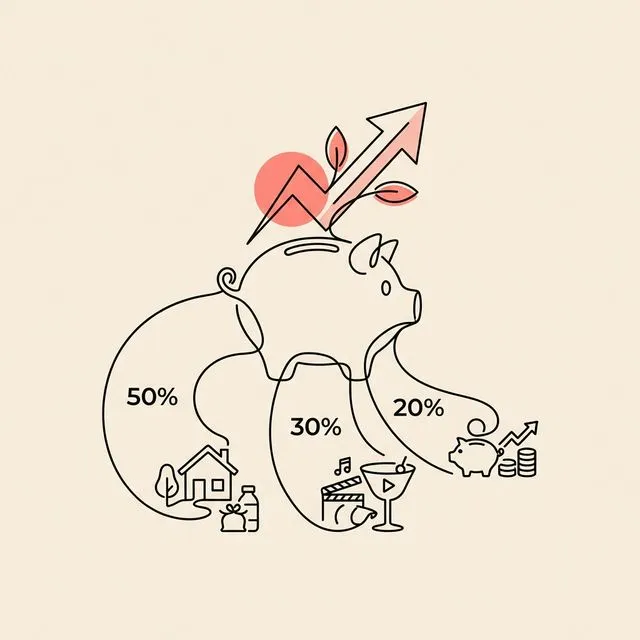
The 50/30/20 budget—allocating 50% of your income to needs, 30% to wants, and 20% to savings or debt—is simple, effective, and built entirely on a flawed assumption for millions of workers: that you receive a steady, predictable paycheck every two weeks.
For freelancers, creators, gig economy workers, and solopreneurs, income is inherently volatile. You might make $8,000 in a banner month and $1,500 the next. Trying to apply a rigid percentage-based framework to a wildly fluctuating baseline is a recipe for frustration and financial anxiety.
However, with a few strategic adjustments, you can utilize the core principles of the 50/30/20 rule to build a sturdy financial foundation, even when your earnings are unpredictable.
The Core Challenge of Variable Income
When your income fluctuates, a strict percentage model fails because your fixed expenses (needs) do not fluctuate with it. Your rent, health insurance, and utility bills cost exactly the same whether you landed three big clients this month or none.
If you apply a flat 50% rule to a weak month, you will mathematically fail to cover your basic living expenses. Conversely, applying a flat 30% “wants” rule to an exceptionally strong month can lead to excessive lifestyle inflation, robbing you of the opportunity to build a powerful financial buffer.
To adapt the 50/30/20 rule for irregular income, you have to separate your baseline needs from your percentage targets.
Strategy 1: Budget on Averages (or Lowest Common Denominators)
The most effective way to stabilize your planning is to establish a reliable baseline income figure.
- Calculate the Average: Add up your net income (after taxes and business expenses) over the last 6 to 12 months. Divide that total by the number of months. Use this average monthly income as your baseline for the 50/30/20 calculation.
- The Conservative Approach: If your income is extremely erratic, base your 50/30/20 budget entirely on your lowest earning month over the past year. By ensuring your “needs” easily fit within 50% (or an adjusted percentage) of your worst-case scenario, you build an unbreakable financial floor.
Strategy 2: The Business vs. Personal Split
A common mistake freelancers make is mingling their business revenue with their personal budget. Your gross revenue isn’t your personal income.
To utilize the 50/30/20 rule properly, you must pay yourself a salary. First, allocate a percentage of your total gross revenue to taxes (e.g., 25-30%) and business expenses. Only after these are deducted should you transfer a fixed, recurring “salary” to your personal checking account.
Apply the 50/30/20 rule only to this personal salary. This mimics the stability of a W-2 paycheck, giving you a fixed number to base your personal needs, wants, and savings off of.
Strategy 3: The Priority Waterfall
When dealing with a highly volatile month where you cannot pay yourself a full salary, apply your income via a prioritized “waterfall” rather than strict percentages.
- Step 1: Cover all essential “Needs.” Until the roof and utilities are paid for, percentages don’t matter.
- Step 2: Fund your Minimum Savings. Instead of allocating to “Wants,” prioritize a base contribution to your emergency fund or minimum debt payments.
- Step 3: With whatever is left over, fund your “Wants” and extra savings.
The Math: Managing a Fluctuation
Imagine a freelancer whose average net income is $5,000/month. Using their average, their target budget is:
- Needs (50%): $2,500
- Wants (30%): $1,500
- Savings (20%): $1,000
In a strong month, they earn $8,000. Instead of increasing their “needs” and “wants” proportionally (which causes lifestyle creep), they maintain their average lifestyle targets ($2,500 Needs, $1,500 Wants) and dramatically boost their savings allocation to $4,000 (50%).
This aggressive savings strategy in good months creates a massive cash buffer that serves as insurance against the inevitable slow months, ensuring that the $2,500 in fixed needs is always met.
Build Your Freelancer Framework
Budgeting with irregular income requires significantly more discipline than relying on a steady corporate paycheck. By establishing a baseline average, separating business and personal revenue, and prioritizing a massive emergency fund during flush months, you can bring predictability to an unpredictable cash flow.
Take Control: Start by visualizing your fixed baseline. Use our 50/30/20 Budget Planner to stress-test your essential needs against conservative income estimates and build a financial plan that works on your terms.
Disclaimer
This analysis is for educational purposes only and does not constitute financial advice. The models presented are projections based on historical data and specific assumptions that may not apply to your unique situation. Always consult with a certified financial professional.
Content on StashPlanner is created with the assistance of Artificial Intelligence. While we fact-check against high-authority sources, AI can occasionally hallucinate or get details wrong. Please use this content as a starting point and always conduct your own due diligence.